
“A powerfully dynamic chocolate, starting with an intense cocoa flavour, with roasted, earthy, tobacco notes and a good clean bitterness […] Once tasted, never forgotten.” That is how chocolate company Veliche describes CACAO OKAPI’s cocoa. This recognition as specialty cocoa is no small feat, especially for Congolese cocoa.
In Mambasa and Irumu, in north-eastern DR Congo’s Ituri province, farmers have been growing cocoa for about twenty years. Most dried their cocoa individually, spread out on the ground or on tarps, and ended up selling it to local buyers at low prices. Inconsistent post-harvest practices impacted the quality, complicating access to international markets. Limited infrastructure, a lack of financial support and technical guidance on good agricultural practices, as well as insufficient organisation posed additional challenges.
Against these odds, CACAO OKAPI grew into a 450-member cooperative exporting high-quality cocoa to international markets, at prices that have gone up from USD1.2 to USD3, with specialty cocoa buyers such as Silva Cacao, Zoto, Olam, Cargill and Veliche. This was not a quick win, but a trajectory that took years of time and a clear vision.
In 2019, encouraged by lab tests that complied with Zoto’s protocols and confirmed the quality of cocoa samples from the region, CACAO OKAPI cooperative was founded with Rikolto’s support. From the start, it envisaged organising cocoa producers collectively to improve the quality of their cocoa and gain access to export markets.
Our long-standing work in eastern DRC’s coffee sector had taught us that quality is a key enabler of higher incomes, and that it is worth focusing on quality first, and volumes later. Building on that knowledge, our support focused on strengthening the application of good agricultural practices and post-harvest practices first, and the cooperative structure and access to markets later on.
As the cooperative’s members grow cocoa on the outskirts of the Okapi Wildlife Reserve, promoting environmentally sustainable practices makes sense: disease- and pest-free seeds, planting according to agronomic standards, regular pruning, composting, use of organic fertilisers and pesticides, and new cocoa plots established in savannah areas, fallow land and secondary forests – outside protected areas. Targeted trainings improved productivity from 200-300 to 500-700 kg/ha, while lowering pressure on the rainforest. These efforts were supported by Rikolto, working alongside the cooperative's technical teams, as part of the UNDP-funded “PIREDD Oriental” programme, and the USAID-funded “Shade-Grown Cocoa” project. Unfortunately, this last one came to a halt in 2025 due to the closure of USAID.
.jpeg)
In addition to these sustainable agricultural practices, producers were trained in post-harvest practices by Rikolto and Zoto, in collaboration with the cooperative’s agronomists. This approach was both part of a Beyond Chocolate-funded project, in a consortium with Zoto, Silva Cacao and Rikolto, as well as of the USAID-funded project. Specifically, these trainings focused on careful sorting to reduce defects, controlled fermentation to develop the full aromatic potential of their cocoa, and homogeneous drying to stabilise quality across lots. In addition, a strategy was introduced to collect fresh cocoa directly from producers and process them centrally at four fermentation and drying centres located close to farming communities.
Beyond collective management of cocoa production, fermentation and drying, Rikolto also supported the cooperative in strengthening its structure and setting up a traceability system aligned with the European Union Deforestation Regulation (EUDR), with financial support from ENABEL and technical assistance from BAHARI Society. To date, 1,032 farms have been geolocated, covering an area of around 2,500 hectares.
.jpeg)
Rikolto also supported the cooperative in understanding international quality requirements, preparing specialty cocoa lots for export and connecting with buyers such as Silva Cacao, Zoto, and Veliche as well as Cargill and Olam. Crucial in this was also connecting the cooperative to trade financing by Société de Microcrédits Congolais (SMICO), a microfinance institution, and Agri-Est, a financial institution, since 2024. This facilitated meeting contractual obligations to buyers and delivering ordered containers on time, translating then into reliable incomes. In 2025, each container generated a gain of between $16,000 and $22,000. In addition, the cooperative has come to an agreement with its members who now mostly supply their fresh cocoa on credit and receive their payment once the container is sold. This helps to improve the cooperative’s income and limits its dependence on bank loans. At the same time, this makes it easier for families to set aside money for investments, in ways that frequent yet smaller payments rarely allow. An important factor to make this possible is that they not depend on cocoa alone: annual crops, tended mostly by women, provide food and a steady stream of income in the meantime.
In 2020, CACAO OKAPI made its first cocoa export with TROPICOR. Between that first export and February 2026, the cooperative commercialised around 277 tonnes of cocoa. Of that, 96 tonnes were exported between 2025 and 2026 alone, representing nearly 35% of the total volume. The bronze medal CACAO OKAPI won at the 2023 International Cocoa of Excellence competition, which was announced in Amsterdam in February 2024, definitely contributed to opening doors to new buyers.
These evolutions demonstrate that the export capacity of the cooperative grew steadily over the course of the past years, translating into additional income for members of the cooperative.
.jpeg)
"Since joining the cooperative, I’m earning more than $1,000 a year. Before, when we were selling outside the cooperative system, I was getting less than $750."
Now, the challenge for CACAO OKAPI is to sustain this “quality mindset” and the export capacity they have built over the years.
Price volatility has tested this. When cocoa prices rose sharply from around $3 to $7.50-8 per kilogram between April and November 2024, producers were able to reinvest in their farms and expand their cultivated areas. When prices dropped again in 2025, we accompanied the cooperative in reinforcing the importance of diversification. Producers began integrating robusta coffee and oil palm into their systems. This decreased dependence on one commodity should lead to greater financial resilience, as we have seen in other programmes we have been supporting, yet its impact will only be felt in about five years.
Furthermore, the security challenges and political instability also meant that some members of the cooperative had to leave their cocoa plantations and homes behind. From our side, we closely monitor the situation, work with local facilitators and take care to relocate activities to safer zones, to support the cooperative and its members in the best way possible.
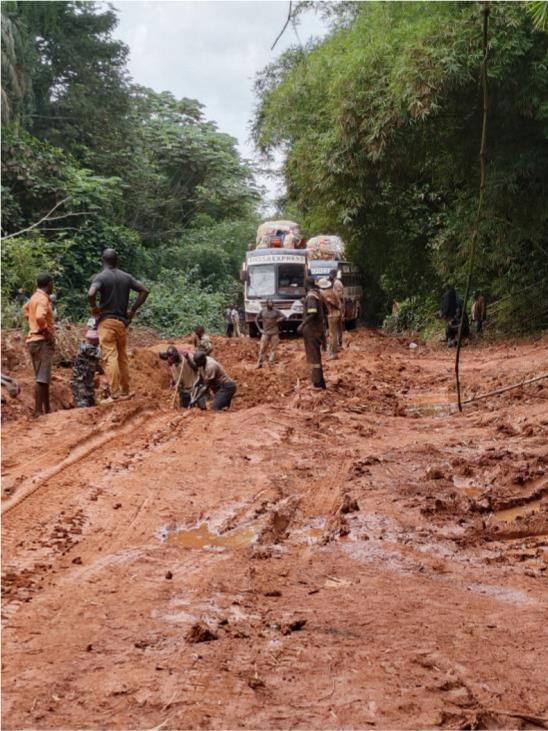
In December 2025, Rikolto facilitated a peer learning visit between CACAO OKAPI and CACAO TSHOPO, a cooperative in Tshopo province we support since 2023 as part of the EU-funded ROSCA project. Producers from both cooperatives observed each other's fermentation and drying protocols, discussed the challenges of cooperative management, and identified practical solutions to quality barriers. The visit prompted concrete action in Tshopo: improvements to post-harvest infrastructure, technical training and steps towards collective marketing, with the same quality-first approach that worked for CACAO OKAPI.
Through the AVENIR project in western DRC, a multi-sector initiative launched in 2025, Rikolto is extending this model further, introducing quality-oriented and market-oriented practices from the outset, rather than retrofitting them later.

Starting from scratch in 2019, CACAO OKAPI now exports certified organic specialty cocoa to international buyers and is an inspiring example to other cooperatives in the DRC. Its trajectory shows the value of collective organisation and a focus on quality throughout, ultimately leading to strong market access. Herein, the financial support of ENABEL, Mercy Corps, DAI, USAID and Beyond Chocolate (IDH) has been instrumental, just as much as the grants of the Vivace Foundation and Alimento, which funded the very first steps of CACAO OKAPI’s trajectory.
Replicated and adapted across different regions in the DRC, this approach could help shift how Congolese cocoa enters international markets. Higher quality, fairer prices, and more durable relationships between producers and the markets they supply are no quick win but undoubtedly pay off in the long run.


.jpg)

.png)
.jpg)
.jpg)