
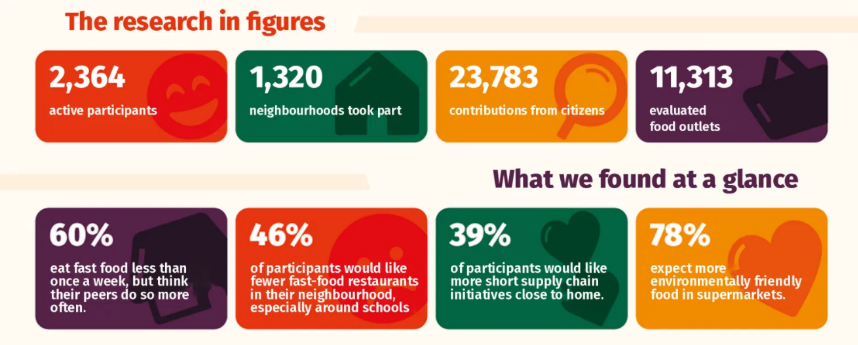
A supermarket on the way home, a fast-food next to the school, a farm shop far away for which you need to make a detour: everyday circumstances like these help determine what ends up on our plate (or doesn't). For ‘The Great Food Map’ (in Dutch: ‘De Grote Voedselkaart’), 2,364 Belgian citizens spent four months mapping how they experience their food environment. They rated thousands of shops, restaurants and other food outlets.
Many participants want to eat healthier, but in practice accessibility, price, opening hours and convenience often carry more weight than health or sustainability.
It is mainly practical matters that determine where people buy their food. Is a shop nearby? Is it on the way home? Can I still get there after work? And how much does it cost?
That may sound obvious, but in discussions about healthy eating habits we still often place the responsibility on the individual. As if everyone simply needs to make slightly better choices. This research shows once again how strongly our environment shapes those choices.
It is all the circumstances that help determine what we eat. Which shops are there in your neighbourhood? What is on the shelves? How much does it cost? Which products are in plain sight or on promotion? But advertising, opening hours, accessibility and our subjective views play a big part.
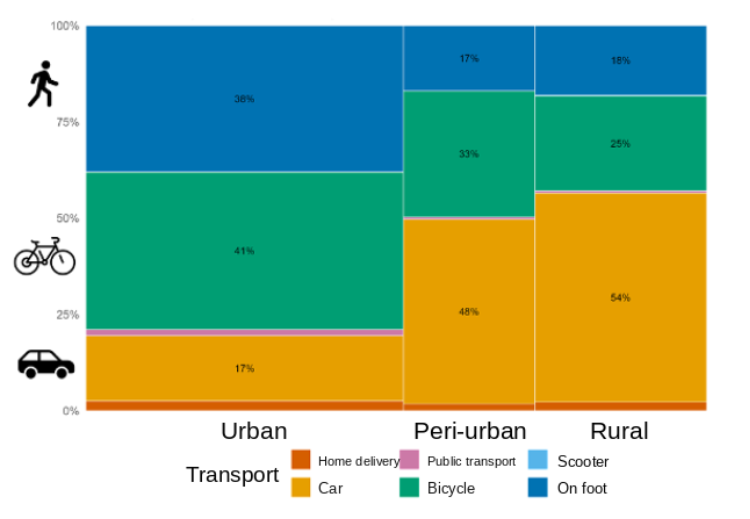
That environment does not look the same for everyone. In a city, you can more often walk or cycle to the shop. In the countryside, you are more likely to need a car. Those with little to spend may opt for a cheaper supermarket a little further away rather than the local shop around the corner.
Food choices are therefore never solely a matter of taste or willpower.
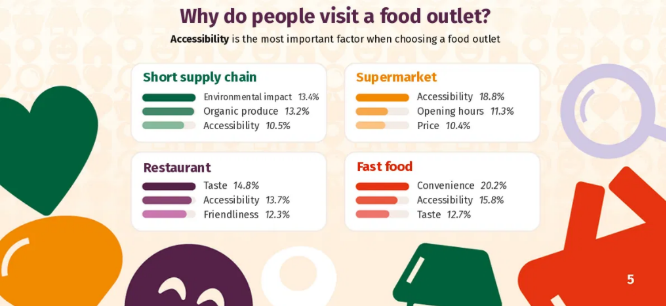
Accessibility is the main factor, followed by taste, friendly staff, convenience and price.
The reasons do vary from place to place. For a supermarket, distance, opening hours and price count the most. For a restaurant, taste and accessibility are important. Fast food appeals mainly because it is easy, close by and tasty.
With short supply chain initiatives, we see something different. There, people more often mention environmental impact and organic produce as a reason to buy there. Quite a lot of people want more farm shops, farmers' markets and collection points in their neighbourhood; this demand is even stronger among people with lower years of education.
Yet people do not automatically buy there more often. Price plays a part, but so does convenience. You sometimes must go round several producers, opening hours are limited and the journey does not always fit into a busy day.

Between April and August 2025, everyone in the region of flanders, Belgium, aged 16 and over could take part via an app. They rated food outlets in their neighbourhood, answered daily questions and were given a new assignment each week.
In total, 4,707 people registered. Of these, 2,364 participants made at least one contribution. Together they accounted for 23,783 contributions and ratings of 5,036 unique food outlets. From supermarkets and restaurants to bakeries, fast-food outlets and farm shops.
The app didn’t just appear out of the blue either. Young people and adults on lower incomes first used photographs to highlight what makes healthy eating easier or more difficult in their neighbourhood. Local authorities, retailers and short-supply-chain initiatives contributed their insights to the research. Rikolto facilitated part of that participatory process and contributed its expertise on sustainable food systems.
Often, yes, but not always. Participants, for example, generally rate unhealthy food outlets as somewhat healthier than nutrition experts do. With the healthiest places, the opposite tends to happen.
Clear information and good labelling therefore remain useful. But that alone will not get us there. A label changes little if the healthy alternative is too expensive or simply isn't on the shelf. And an excess of labels does not help us move forward either.
No. Participants who struggle to make ends meet are less satisfied with the variety and quality of what is on offer. They less often cite accessibility as a reason for their visit, which, according to the researchers, may indicate that other considerations, such as price, weigh more heavily.
In rural areas, shops are on average further away and the car is used more often to do the shopping.
We do need to be careful with statements about “the Flemish”. Three quarters of participants were highly educated and almost three quarters were women. Moreover, a small group of very active users accounted for most of the ratings.
The research tells us a great deal about how a large group of engaged citizens experiences its food environment. But that group is not a perfect reflection of Flanders.
That also holds a lesson for a future edition. An app is handy, but it does not automatically reach everyone. If we really want to involve people in vulnerable situations, we must also provide local support and ways of taking part without a smartphone.
Ordinary citizens on the one hand and people with a professional background in nutrition and health on the other placed different emphasis on how to make the food environment healthier. Nevertheless, we see four actions that both groups give high priority:
That combination is important. It contains actions that retailers, local authorities, producers and the Flemish government must work on. The responsibility does not lie with a single party.
The map has been made. There is plenty we can get to work on.
For us at Rikolto, the work does not stop at a report. Together with citizens, businesses and governments, we want to try out which solutions work in practice.
For instance, in Leuven we will soon be testing, with several schools and supermarkets, how the environment in and around schools makes healthy choices easier and more attractive. We will also be getting to work with logistics hubs to get local produce to more shops, schools and healthcare institutions more efficiently.


.png)
.jpg)