


Belgian supermarkets still primarily promote meat and dairy in their brochures despite ambitious climate targets. Colruyt and Lidl, however, have promising policies to encourage plant-based eating habits. The Superlist Environment Belgium 2026 report puts those efforts into lights. As well as covering the topics of climate and protein transition, the report provides insight into performance about a sustainable product range and food waste. Download the full report from the Questionmark website.
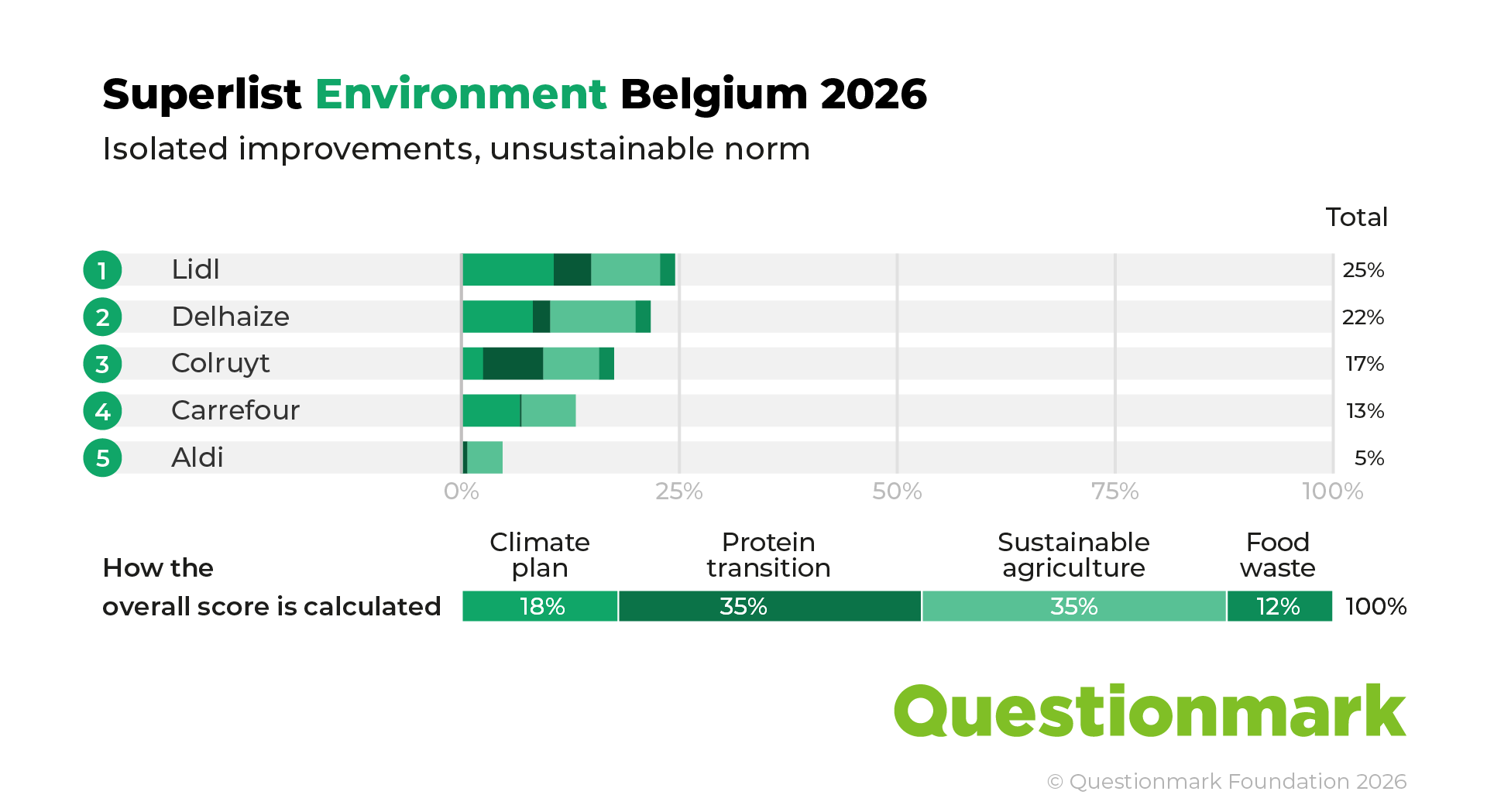
The report by think tank Questionmark reveals the efforts of the five largest supermarkets in Belgium to combat climate change and protect the environment. Lidl and Delhaize are at the top of the ranking, followed by Colruyt, Carrefour and finally Aldi.
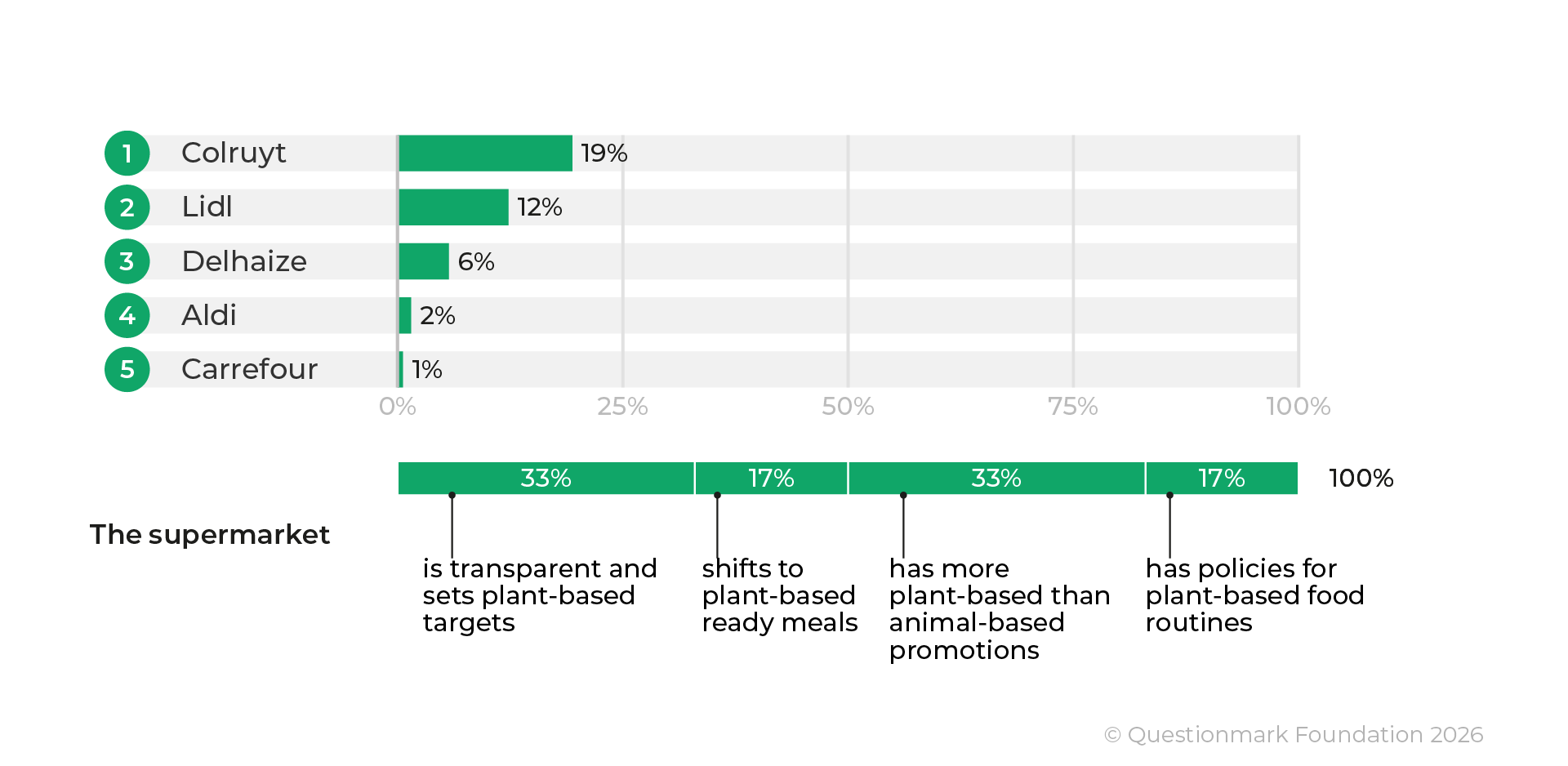
However, the research shows that supermarkets are missing opportunities to achieve their climate goals. Only 6% of ready-made meals on store shelves contain no animal ingredients. For every plant-based offer, there are nine promotions for meat or dairy products. Furthermore, approximately 75% of processed meats are sold in 'large' to 'extra-large' portions, encouraging overconsumption. These figures have hardly changed since the previous Superlist Belgium in 2022. Supermarkets continue to actively encourage consumers to adopt a diet high in meat and dairy products.
Reducing our consumption of animal products and increasing our consumption of plant-based foods is an important step in stopping global warming. Animal products are responsible for half of the greenhouse gas emissions within our food system. For this reason, the Flemish government launched the 'Half-Half' campaign, which encourages people to choose a plant-based meal for half of the week. As influential entities within our food system, supermarkets have the power to make a significant impact: they can provide their customers with optimal choices through their product range, promotional offers, store environment and pricing strategy, while also leveraging their purchasing policies to encourage farmers to adopt more sustainable agricultural practices.
There are also some promising practices emerging. For example, Lidl is trying to boost sales of plant-based meals by pricing them the same as animal products and placing them strategically in the meat aisle. Furthermore, Lidl, Colruyt and Delhaize are focusing their policies on hybrid products that are partly animal-based and partly plant-based.
Notably, Colruyt has increased its promotions on plant-based products. Within high-protein promotions, almost 25% are now plant-based compared to 75% featuring meat or dairy products. In 2022, only 5% of promotions were plant-based. Other supermarkets are barely making progress, with 9 out of 10 promotions still featuring animal products.
All supermarkets signed the Flemish 'Green Deal Protein Shift on Our Plate' in 2020, with the aim of increasing plant-based protein consumption to 60% by 2030. This objective is in danger of not being met.
Charlotte Linnebank, director of the think tank Questionmark, welcomes concrete steps such as equal pricing and smart placement, but says these are too fragmented: "These actions are a good start, but more coherence is needed for a real breakthrough. We encourage supermarkets to take control of their entire sales strategy. The transition should be visible on the shelves, not just in annual reports.”
The Superlist Environment Belgium 2026 report was produced in collaboration with Rikolto and with the support of Testaankoop, BOS+, Bond Beter Leefmilieu and Écoconso. Jelle Goossens of Rikolto, a Belgian NGO that promotes sustainable food systems, also believes that the government has an important role to play: "The government must ensure uniform rules so that all supermarkets move in the same direction, promoting less meat and selling more plant-based and hybrid products" This way, frontrunners are not penalised, and producers and farmers are given the certainty to make the switch alongside them.”

Download the report.
Superlist is an initiative of think tank Questionmark. Dive into the results and download the report on their website. You will also find the methodology and raw data there.
.png)
According to the report, other effective climate actions include offering only deforestation-free and organic products, reducing food waste and creating a robust climate plan.
Thanks to recent European legislation, food grown in areas deforested after 2020 cannot be sold in supermarkets. While supermarkets appear to be complying with this legislation, most are not transparent about it or making any additional efforts. Delhaize, one of the report's frontrunners, commits to opposing land conversion in nature reserves not covered by European anti-deforestation legislation, including savannas, wetlands, and grasslands.
Delhaize also scores highest in terms of transparency regarding origin, certification, and transport, while Aldi, Carrefour, and Colruyt lag due to their outdated reporting methods. Additionally, the sustainable assortment presents a mixed picture: Lidl is taking a notable step backward by removing certified dairy products.
While food waste within the organisation itself is being limited, there is no clear action plan against waste among their buyers and customers. However, this is where most waste occurs, and supermarkets have significant influence here.
Finally, none of the supermarkets currently show a clear decrease in greenhouse gas emissions. However, Lidl, Delhaize and Carrefour do have detailed plans to meet their 2030 climate goals. Additionally, Lidl plans to be 'net zero' by 2050.
Share this page and the above press release with your friends, family and professional network. The more people who are aware of the key role of supermarkets, the faster we can change our food system.
Share our online Super Quiz and, through ten questions, discover how super(market) smart you are and stand a chance to win a Rikolto shopping bag filled with local treats.
Even better, invite us to your organisation or association. We will organise a free workshop about the results and would love to hear what your ideal supermarket looks like. We will take your suggestions into account when we discuss the issue with supermarkets and government authorities.
Superlist Environment Belgium 2026 is an initiative of the think tank Questionmark, in collaboration with Rikolto, and supported by Bond Beter Leefmilieu, BOS+, Test-Aankoop and Écoconso.
Rikolto is a partner of Superlist Environment Belgium 2026, supported by the European Union, Belgian Development Cooperation, the Flemish Department of Environment, the National Lottery and De Standaard.
.png)

.png)
.jpg)


.jpg)