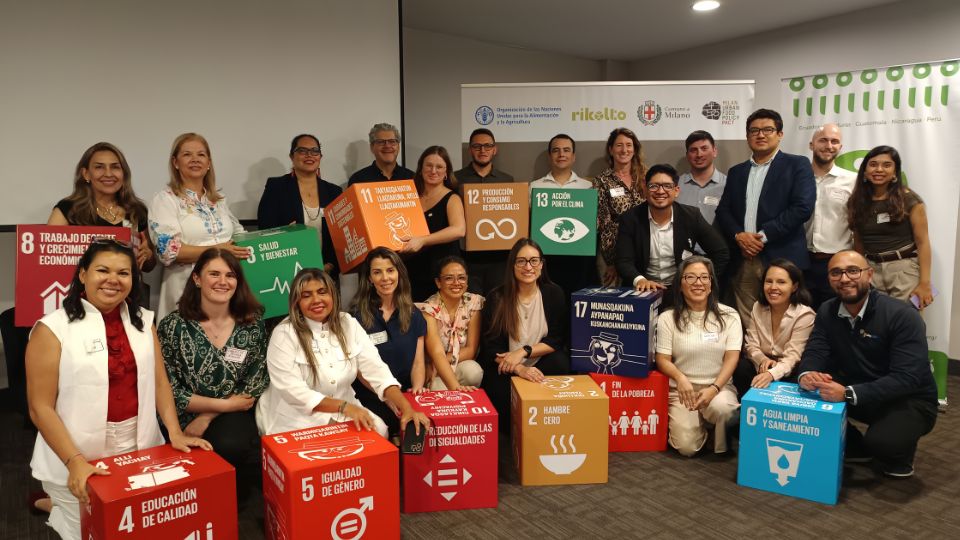
What can we do to avoid wasting food that is still good for consumption? 8 representatives of local governments from six Latin American countries met in Lima to exchange experiences and make progress on solutions to prevent food waste and make better use of the resources of urban food systems.
The international meeting of the initiative "Less is More: Scaling up efforts to reduce food loss and waste by promoting the circular economy at city level", held from 29 September to 1 October 2026 and organised by the Food and Agriculture Organization of the United Nations (FAO), the Milan Urban Food Policy Pact (MUFPP) and Rikolto, made it possible to share solutions, learn about on-the-ground experiences, and design actions adapted to the needs of each city.
Delegations from Peru, Ecuador, Colombia, Argentina, Costa Rica and Brazil took part, coming from the province of Maynas and the cities of Lima, Cuenca, Barranquilla, Tandil, Santa Ana, Bogotá, Rosario and Curitiba.


The "Less is More" initiative seeks to strengthen the capacities of local governments to prevent food waste and promote the circular economy through peer learning and South-South and triangular cooperation. The programme consists of six virtual sessions in addition to the in-person meeting, which are scheduled between July and October 2026. Up to the fifth session, the process had 258 officials and 73 registered cities, which are analysing their territorial challenges and sharing good practices.
The goal is to help incorporate food waste prevention into urban planning, strengthen policies and regulations, and improve coordination among municipalities, civil society, businesses, producers, processors, households and communities.
For Dina Luz Pardo, representative of the city of Barranquilla, Colombia, the exchange made it possible to recognise common elements in the municipal experiences. "I am taking away many ideas about what municipalities are doing to prevent food waste. All the experiences have two important points in common: the commitment and initiative of those who manage them, and multilevel and inter-institutional coordination. People's commitment is the most important thing," she said.
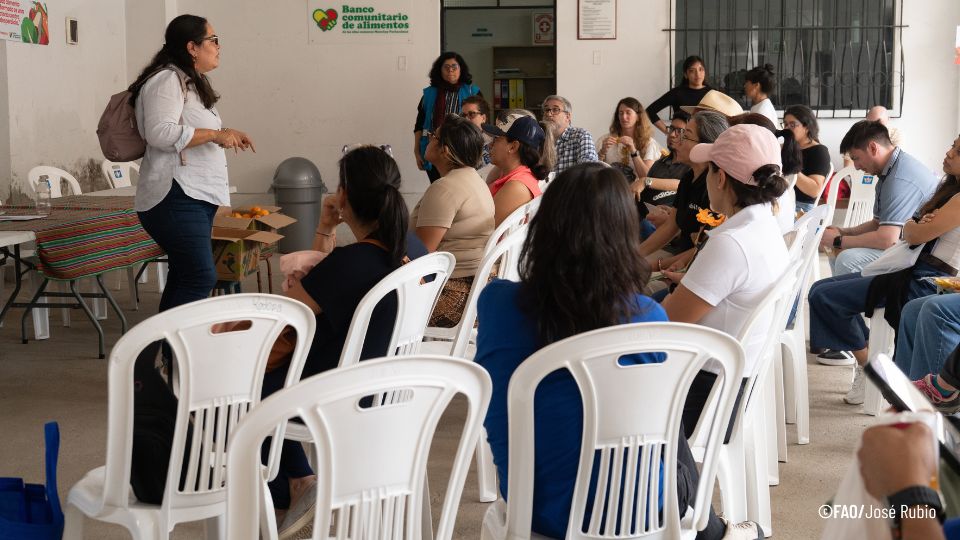
María Eugenia Hulten, from the city of Rosario, Argentina, highlighted the need to strengthen joint work among different actors. "We were talking about the importance of coordination between academia, the government and organisations. We understand that there is no other way to operate: these spaces for coordination, meeting, systematisation and support are necessary,” she stated.
During the meeting, the delegations visited three initiatives in Lima focusing on food recovery and the recovery of value from organic waste:
Alejandro Velez, representative of Bogotá, Colombia, highlighted the importance of seeing these experiences up close and the possibilities for coordination between initiatives. "You always see how difficult it is to coordinate, to connect everything. Today we realised that, even though we went to different places, everything is connected. I was very impressed by the wholesale food market (central de abastos). It is very similar in size to the one we have in Bogotá, but the organisation and the food recovery process are completely different," he commented.
The visits allowed reflection on the potential of markets, community organisations and other local initiatives to prevent waste, recover and redistribute food surpluses, and reintroduce resources into new production cycles.
During the exchange, cities such as Rosario, Bogotá and Curitiba shared their progress in identifying enabling conditions and alternatives that could be adapted to other territories. The dialogue also made it possible to advance regulatory proposals and ideas for pilot projects, as well as to identify risks, opportunities for improvement and the conditions needed for their implementation.
To end the meeting, each city presented a priority short- and medium-term municipal action, with the commitment to pass on the lessons learned to their authorities, technical teams and municipal bodies.
Jennifer Montoya, representative of the province of Maynas, Peru, emphasised the value of learning about other experiences to improve local initiatives. "From our territories, we believe we are doing everything right. This sharing between expert cities and those that are at the diagnostic stage or making progress is essential so that we can improve and correct ourselves. We have asked for all the details to know how to replicate it," she said.
Along the same lines, Raquel Hernández, from the city of Santa Ana, Costa Rica, highlighted the opportunities offered by regional collaboration: "In the region we are very diverse, but we often have the same problems. (Now) we can learn from everything we saw and create these connections to find out what is happening in other countries, which may well be a solution for ours too."
Through "Less is More", FAO, the MUFPP and Rikolto promote peer learning and regional exchange to drive concrete local responses, strengthen policy-making and encourage joint actions that contribute to building more sustainable, inclusive, resilient and circular urban food systems.