
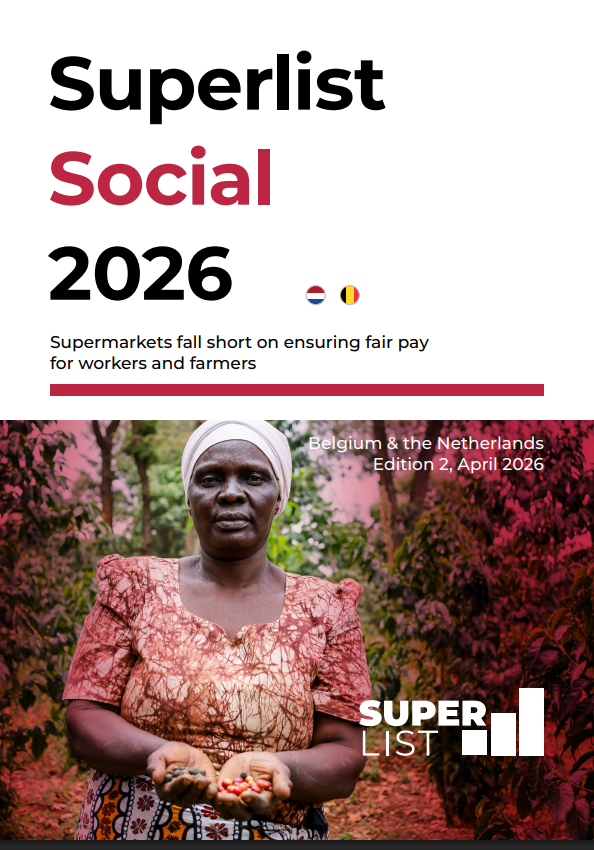
All major supermarkets in Belgium can do much more for farmers and agricultural workers in their supply chains. Lidl is performing significantly better than the rest, while Colruyt, a major Belgian supermarket chain, is catching up. This is according to Superlist Social 2026, the human rights report on Belgian and Dutch supermarkets by Questionmark Foundation, in collaboration with Rikolto, Oxfam Novib, and Solidaridad, and with the support of Fairtrade Belgium and Oxfam Belgium.
.png)

Farmers and agricultural workers worldwide are often underpaid and, partly as a result, face poverty, child labour, and forced labour.
Supermarkets can do a great deal to combat these abuses in their supply chains. Superlist Social Belgium & the Nederland 2026 compares their efforts.
The full report can be found on the website of Questionmark Foundation, the initiator of Superlijst.
Liesbeth Van Meulder, an expert in sustainable coffee and cocoa supply chains at Rikolto, shares her insights:

"When a supermarket commits to fair incomes, women's rights, or combating exploitation, we make substantial progress in the lives of workers and farmers, their families, their fields, and their living environment. The leadership of supermarkets in guaranteeing human rights creates a cascade throughout the chain."
We already see this in cocoa supply chains, for example. The Living Income programme for Lidl's chocolate bars is based on the Way-to-Go model that Lidl developed together with Rikolto and Fairtrade Belgium. We also collaborated with Colruyt on the model that now guarantees a living income for all Boni (Colruyt's own private label brand) bars.
But domestically as well, we strive for sustainable and stable business models for farmers, for example for protein-rich crops such as chickpeas.
.png)
These stable business models are no unnecessary luxury in an increasingly unstable world. Disruption in food chains is increasingly becoming the norm due to climate crises and political unrest. Stable and inclusive trade relations are therefore becoming not only an ethical but also increasingly a strategic priority. Fair trade is now a matter of 'de-risking' for all trading partners.
That is why Rikolto is once again a partner of Superlist Social this year. This report shows not only that there is still a long way to go to ensure a fair offering in stores, but it also shows the path towards it. The successes in cocoa chains, for example, can offer inspiration to take steps now for coffee, another high-risk chain. Supermarkets can play a key role there as well.
.png)
Citizens do not want to unknowingly contribute to human rights violations through their groceries, as is clearly evident from our citizen panels. Moreover, citizens want policymakers to take action on this too. The upcoming European Due Diligence Act (a European Union legislation requiring companies to identify and address human rights and environmental risks in their supply chains) is a significant step forward, but domestic authorities can also set the societal bar high enough.
That is why we work together with supermarkets, governments, farmers, citizens, and other actors. Only through cooperation throughout the entire food system can we gradually achieve a truly fair shopping basket.
Superlijst Sociaal is an initiative of Questionmark Foundation in collaboration with Rikolto, Oxfam Novib and Solidaridad, and with the support of Fairtrade Belgium and Oxfam Belgium.
Rikolto is a partner of Superlist Sociaal with the support of Belgian Development Cooperation, the Flemish Department of Environment, and De Standaard.

For more insights about this report, visit www.rikolto.be/superlijst-sociaal-2026


.png)
.jpg)

.jpg)