

Rice is a staple food in Benin, but its production is highly vulnerable to climate change. To reduce dependence on imports, promote sustainable rice "made in Benin" and strengthen farmers' resilience, Rikolto and the CCR-B are renewing their collaboration via the Programme for Resilient Agriculture and Sustainable Food Systems (PARSAD), which is funded by Enabel. Based on the successes of the DEFIA programme, the project will consolidate and expand the agroecological practices already promoted in Agricultural Development Hubs (Pôles de Développement Agricole - PDAs) 5, 6 and 7 to include PDA 4, with the aim of accelerating the sustainable transformation of the rice sector.
Benin has great potential for producing high-quality local rice, and the DEFIA programme has made significant progress in the south of the country, notably by promoting the Sustainable Rice Platform (SRP) standard, which assesses the sustainability of rice production based on ecological, economic and social criteria. However, several challenges still hinder a sustainable, large-scale transition to agroecology:
.png)

The project is implemented by Rikolto in a consortium with the Benin Rice Farmers' Concertation Council (CCR-B). Together, we support rice-farming families, cooperatives, and local businesses in transitioning toward more sustainable and resilient farming practices. This transition can only succeed if it is co-created and driven by local actors themselves. Therefore, the project combines technical coaching, field experimentation, market structuring, and the strengthening of local organisations.
Rikolto plays a key role in technical coaching, partnership coordination, and testing practices in the field. Twenty-four (24) advisors from the CCR-B will be trained and supervised by Rikolto to train 140 lead rice farmers. Farmer Field Schools (FFS) will be established directly in the rice fields. These co-learning spaces will enable farmers to compare agroecological techniques with conventional methods side by side, helping lead farmers to encourage 6,645 neighbouring producers to adopt agroecological practices.
« The peer-to-peer training approach has proven its worth beyond doubt. Under the DEFIA programme, it increased the participation of rice farmers by over 46.7% between 2022 and 2023. Building on these achievements, particularly the 11 educational manuals developed with INRAB (the National Institute of Agricultural Research of Benin), we are working to further strengthen and spread agroecological practices within rice-farming communities. »
Kossi Pascal GBAYI - Rice Programme Manager in Beninµ

The project guides producers through the gradual adoption of farming practices aligned with the Sustainable Rice Platform (SRP) standard, which provides the framework for boosting the ecological, economic, and social sustainability of rice production. Special attention is given to water management, soil fertility, and reducing chemical input use.
Promoted practices include using organic inputs like vermicompost and vermicompost tea, neem-oil-coated urea, implementing the System of Rice Intensification (SRI) to optimize resources while boosting yields, and Alternate Wetting and Drying (AWD) to save water.
The project will also roll out a 'SMART-Valley' pilot initiative in Hub 4, a low-cost, participatory approach to developing inland valleys using local resources to improve water management.
The project goes beyond farming to mobilise all actors along the rice value chain, from production to marketing. To this end and in partnership with Enabel, we will foster collaboration within 'rice clusters', uniting producers, processors, and traders around a shared objective. Our aim is to improve coordination in order to upgrade the quality of Beninese rice, establish more stable and transparent commercial relationships, and increase the supply of local rice to major urban centres such as Cotonou, Porto-Novo and Bohicon.
Specifically, cooperatives and small and medium-sized enterprises (SMEs) will receive support to:
The project will also support the growth of a service ecosystem around the rice sector. Local seed producers, agroecological input suppliers, and young technical service providers will receive support to tailor their businesses to farmers' needs. Enabel and the CCR-B will set up a self-managed mechanism for accessing agroecological inputs. In exchange for smoother access to inputs and financing, farmer cooperatives commit to regularly delivering high-quality paddy rice to the CCR-B Services Cooperative processing center.
In PDA 4, Rikolto will work with young women to set up a franchise model for producing parboiled rice. The aim is to increase both the volume and quality of production in order to supply institutional markets, such as schools, as well as local ones.
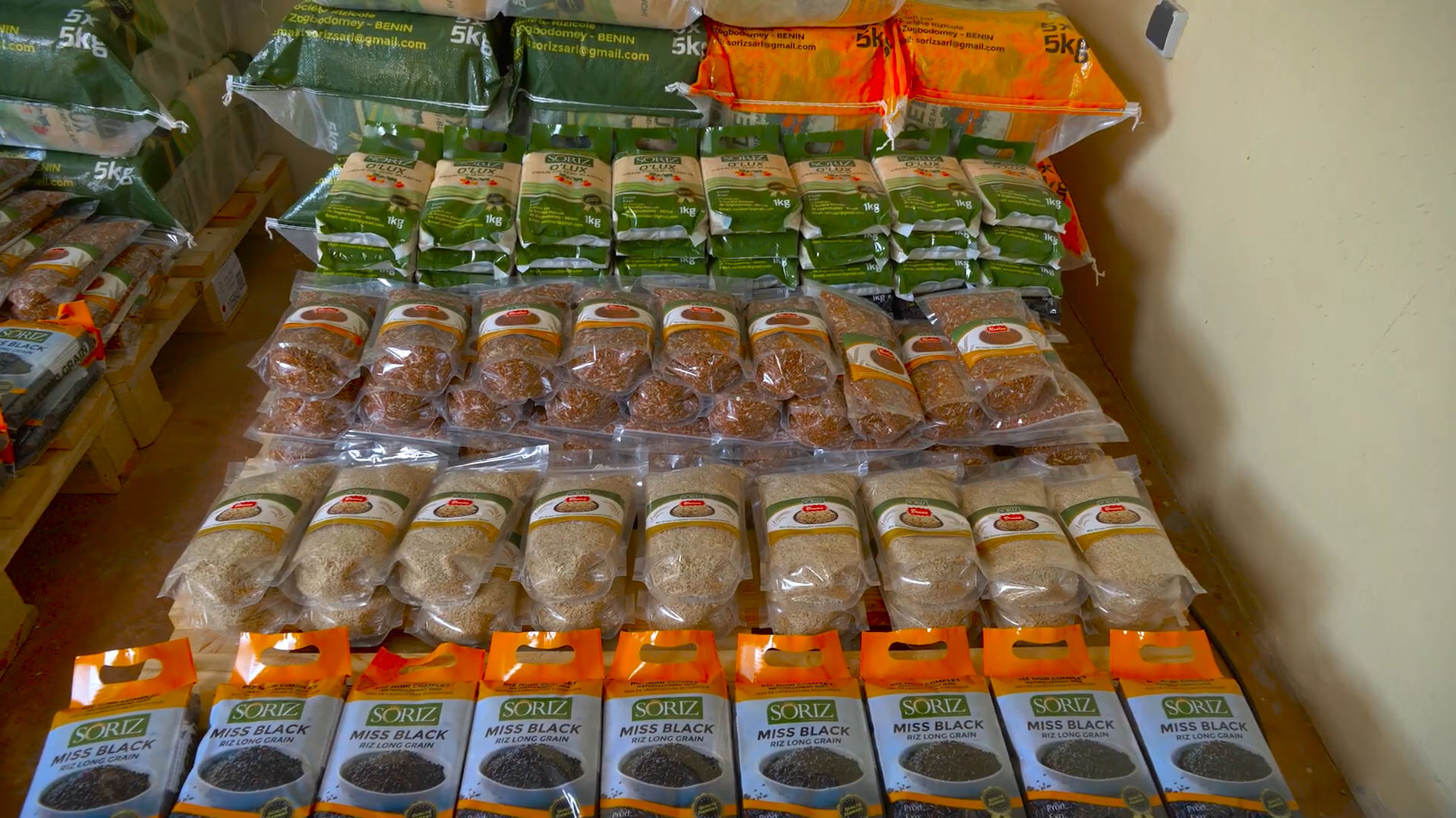
Finally, the project aims to foster an environment that champions Beninese rice. In collaboration with the Benin Rice Sector Interprofessional Body (IFRIZ-B) and members of the rice clusters, we will run promotional campaigns to connect producers and consumers. These will include awareness campaigns, trade fairs, tastings and business-to-business meetings, all designed to raise the profile of local rice, demonstrate its quality and encourage urban consumers to trust the "Made in Benin" brand.
By 2026, 4,317 producers (including 1,796 women) have been supported through a network of 72 Farmer Field Schools. Thanks to the adoption of good agricultural practices, the 2025 campaign generated 7,840 tonnes of rice classified as either "sustainable" (882 tonnes) or "moving toward sustainable" (7,258 tonnes).
As Rikolto introduced the approach in the PDA 4 hub for the first time, farmers were more receptive to the intervention. Combined with close, hands-on technical support, this resulted in high adoption rates of good agricultural practices and a nearly 26% reduction in methane emissions through improved on-plot water management (from 1,277 kg/ha to 939 kg/ha in one year).
Faced with the climate and economic hurdles of the 2025–2026 campaign (drought and high input prices), farmers successfully adapted using educational materials developed by INRAB and Rikolto (one of the results of the DEFIA programme). They built small bunds to retain rainwater and utilised organic fertilizers like cow dung and legume cover crops.
Despite these successes, there is room for improvement in record-keeping, pesticide safety and post-harvest management. Specifically, poor straw management remains a structural weakness due to the practice of persistent burning, transport and logistics constraints, and a lack of recognition of its economic value. However, PDA 4 farmers have been much more proactive in this area than those in the south. Regarding chemical inputs:
In terms of seed usage, the South recorded a remarkable 45% reduction thanks to row planting and growing trust in certified seeds, which led to a direct cut in production costs. In contrast, PDA 4 only saw an 8% decrease, held back by concerns about potential productivity losses.
To consolidate these new practices and reassure hesitant farmers, the project will keep its 'open-air schools' alive. The aim is to demonstrate, through practical examples, that it is possible to produce better results while using fewer resources. The CCR-B and Rikolto teams remain fully mobilised in the fields to guide farmers daily and address their concerns.
------------------------------------------
1 Inovations like vermicomposting and vermicompost tea yielded positive results in the DEFIA program's Farmer Field Schools, but scaling them up further is necessary. Despite a 38.8% increase between 2022 and 2023, adoption practices still sit at 7.5% of the SRP threshold.
2 Practices here have reached 64% of the SRP threshold, following a 69.4% improvement between 2022 and 2023. The long-term efficiency of the motor pumps and the SMART-Valley initiative still needs to be assessed over a longer period.
3 Despite a 15.5% improvement between 2022 and 2023, value chain actors still sit at 15.9% of the SRP requirement threshold. This topic spans all dimensions of decent work, including income and employment security, social protection, working conditions, occupational health and safety, fair treatment, work-life balance, and representation.
The project also benefits from scientific and educational backing from the National Institute of Agricultural Research of Benin (INRAB), as well as support from the Benin Rice Sector Interprofessional Body (IFRIZ-B) for promoting local rice and raising consumer awareness.


.jpg)


.jpg)