
In 2022, Rikolto launched the project “Lowering the heat, feeding citizens, scaling up a circular model for urban agriculture in Depok City, Indonesia”, supported by funding from the Government of Flanders through their Flanders International Climate Action Programme (VIKAP).
From the outset, the project was not intended merely to encourage urban residents to grow vegetables. Its broader aim was to explore whether urban agriculture could help address rising urban temperatures—known as the Urban Heat Island (UHI) effect, which occurs when cities become warmer as green spaces are replaced by asphalt, concrete, and other heat-absorbing surfaces—while also strengthening sustainable access to healthy food for urban residents.
.png)
To implement the pilot phase of the project, Rikolto partnered with the Faculty of Agriculture at IPB University, and the NGO Perkumpulan Indonesia Berseru (PIB). This collaboration proved to be key, as sustainable urban agriculture requires two elements at once: a strong scientific foundation and grounded, community-level support.
Rikolto worked with six urban farming groups in the city of Depok, West Java. These groups were not professional farmers, like those commonly found in rural areas—many of whom have farmed for decades or come from farming families.
The members of these urban farming groups were city residents, including workers, homemakers, and community organisers. They began gardening for a range of reasons: personal interest, a desire to access healthy food, or simply to try something new. This experience shaped the project’s implementation process, particularly during its early stages.
I still clearly recall a candid reflection shared by Prof. Dr. Ir. Suryo Wiyono, Dean of the Faculty of Agriculture at IPB University, widely known as Prof. Suryo, during the early stages of the project. At the time, most of the supported groups still viewed urban farming as a hobby—something done in their spare time, rather than an activity pursued with clear, productive goals.
This tendency was clearly reflected in their response when chilli plants were attacked by pests. The participants were reluctant to remove infected plants, often out of emotional attachment. Yet, pests can easily spread to other productive plants, and one of the most effective ways to stop the spread is to remove plants that have already been infected.
That was three years ago. Today, the change is very evident. When we visited the farming sites managed by the groups on 15 December 2025, what we saw were no longer just demonstration plots. Instead, nearly all of the sites were well maintained, productive, and continuing to develop. The farms now follow more structured planting patterns, and it is clear that decisions around cultivation practices are being made with greater confidence and maturity.
.png)
One of the groups that made the strongest impression on me was the KWT Sosial 3 farmers group, named after the street on which they are located. They initially began with a single urban farming demonstration plot. Today, they manage land across four different locations in the city of Depok. One of these plots is almost ‘hidden’ from view. Although it is located not far from a main road, people passing by are rarely aware that an urban farming site exists there. To reach it, one must enter through a narrow alley flanked by rows of typical urban housing.
Yet, upon reaching the end of the alley, the scene changes immediately. Chilli plants grow in neat rows on one side, while aubergines fill the other. In the centre, there are plots containing a variety of vegetables. On the same site, KWT Sosial 3 also manages organic waste through maggot cultivation in one corner of the land. This site is beyond a garden, it’s a small, interconnected ecosystem.
At the KWT Demangan site, another supported urban farming group, members grow vegetables and chillies, and also cultivate fruit trees such as avocados and starfruit, adding greater diversity to their harvests. This diversity is important, as urban food systems cannot realistically rely on a single commodity, and cities also need green spaces that perform important ecological functions.
Our visit to the KWT Sejahtera site was a motivating and inspiring experience. Upon arrival, we were welcomed with dishes prepared from their own harvest—ranging from cooked fish, fresh vegetables with aubergine sambal, and sour vegetable soup, to fruit pickles, and fresh avocados.
The shared meal may have been simple, but it conveyed a powerful message to us: urban food security is achievable.
Urban agriculture can take root in the gaps of the city, even on land that appears far from ‘ideal’, such as former construction waste sites, riverbanks, unused plots of land, or narrow alleyways. It is precisely here that the most important value of urban agriculture lies.
Equally important, this urban agriculture initiative is carried out using a sustainable approach, without the use of chemicals or pesticides. This is because the ultimate goal is not merely to produce a harvest, but also to protect the health of residents and the environment.
What, then, is the connection between urban agriculture and climate? Research support from IPB provided scientific evidence that urban farming, often perceived as merely a “green initiative”, it delivers measurable climate benefits, even at small urban scale.
Dr. Idung Risdiyanto, a lecturer and researcher in the Department of Geophysics and Meteorology at IPB, conducted research across six demonstration plot sites over the project’s three-year implementation period.
One particularly positive finding was the estimated carbon sequestration potential of 24.9 tonnes of CO₂e per hectare per year. This figure is comparable in scale to the carbon sequestration capacity of tropical forests, which is estimated at approximately 38 tonnes of CO₂ per hectare per year and is achieved through the process of plant photosynthesis.
These findings were later shared with the supported groups and became a source of motivation for their members. They came to realise that the urban farming practices they were implementing were not only beneficial for food production, but also contributed positively to the local climate, but also contributed to reducing health risks associated with heat exposure for nearby residents.

Urban agriculture influences local air temperatures through a combination of shading, moisture regulation, and surface cooling, operating through several simple but impactful mechanisms:
In essence, urban agriculture can function as a micro-cooling system in dense residential areas such as Depok. This role helps reduce the Urban Heat Island (UHI) effect, while strengthening the city’s adaptation to climate change.
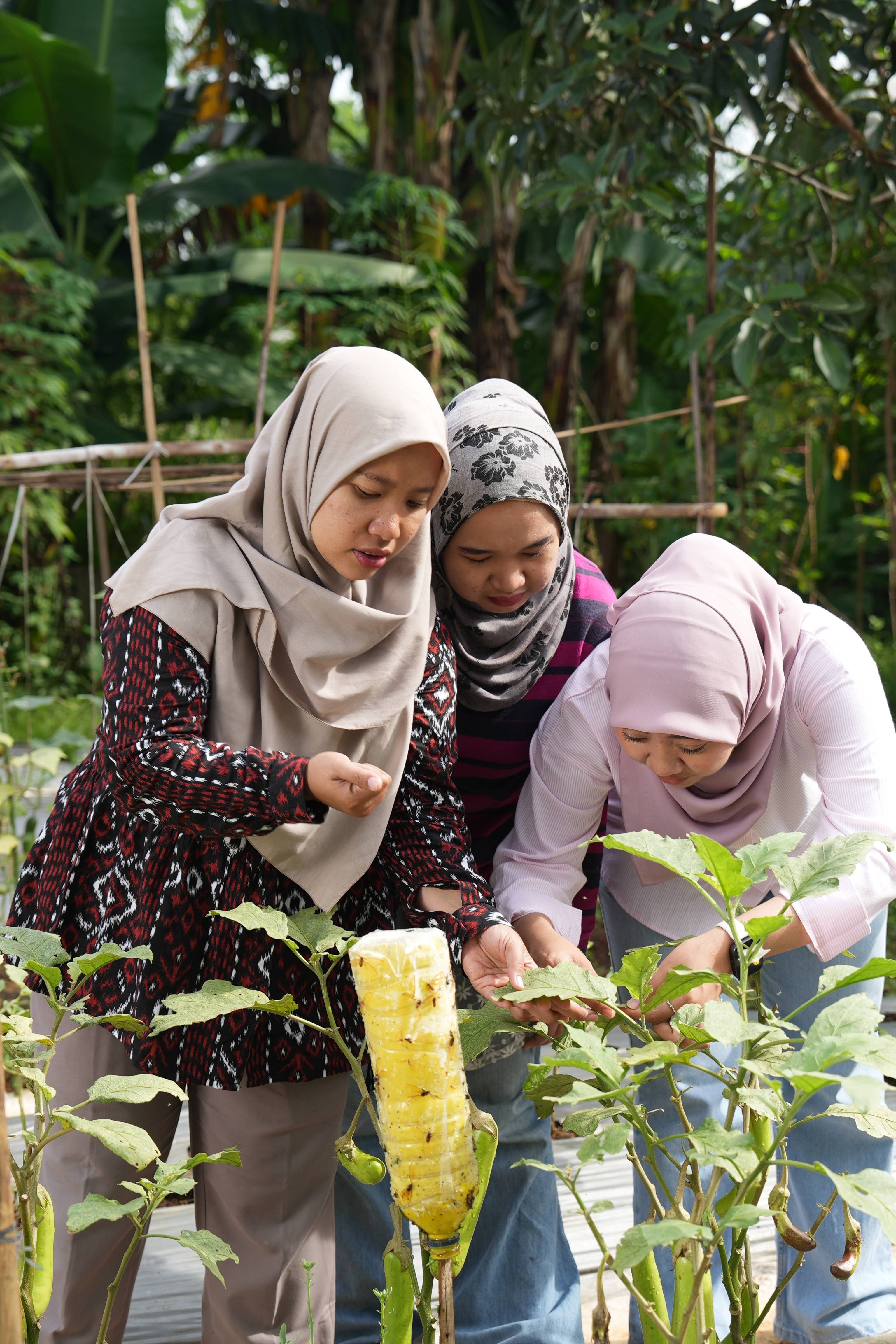
In projects of this kind, ‘farming’ is not simply about choosing the right seeds and preparing the land. Technical decisions are required throughout the process, from soil management and pest control, to selecting suitable varieties, reading weather conditions, and maintaining land sustainability over the long term.
This is where the partnership with IPB plays a significant role. The collaboration gave the participants the opportunity to learn from credible scientific sources,, rather than simply replicating practices or trends from social media that may not be suitable for urban contexts. Training and mentoring provided by IPB help ensure that cultivation practices are more targeted, while also strengthening the confidence of the groups in making decisions.
Meanwhile, the Berseru (PIB) association works with close ties to the community. They work closely with residents in their day-to-day activities, listening to concerns, engaging in open dialogue, and helping identify realistic and practical solutions. One of the most important outcomes is Dasmap—a city map that identifies urban farming locations in Depok, food-sharing initiatives, and waste management activities.
.png)
To date, Dasmap has documented 147 farmer groups/KWT/Pokdakan, 80 urban farming communities, 46 government-run waste processing units, and 11 non-government waste processing units, as well as 9 food and agriculture education sites, 18 healthy food kiosks, and various food-sharing initiatives. For the City Government of Depok, this evidence base is essential, as effective urban policy requires a clear base and direction—not enthusiasm alone.
Based on the project’s results, the progress of the communities involved, and the evidence of benefits generated, urban agriculture deserves far greater attention. It should be seen not merely as an additional community activity, but as an integral part of urban strategies to address extreme heat, climate crises, and food vulnerability.
.png)
If the City of Depok seeks to strengthen its resilience in ensuring food availability while protecting residents from the impacts of extreme heat, then adequate policy support and budget allocation for the development of urban agriculture are essential. It is time for urban agriculture to be viewed not merely as an “environmental programme”, but as a strategic investment in climate resilience.
As conveyed by Dr. Idung during the project dissemination event held on 15 December 2025: “Let us plant. From a single plant, we not only harvest food for consumption, but also build cities that are cooler, healthier, and better prepared to face future climate and food pressures.”
With the support of the Flemish government

---
Translated and lightly edited from the original article on our Southeast Asia website. Read it here.
Picture credits: Ari Angin

RikoltoPortraits-42.JPG)

.png)
.jpg)


.jpg)